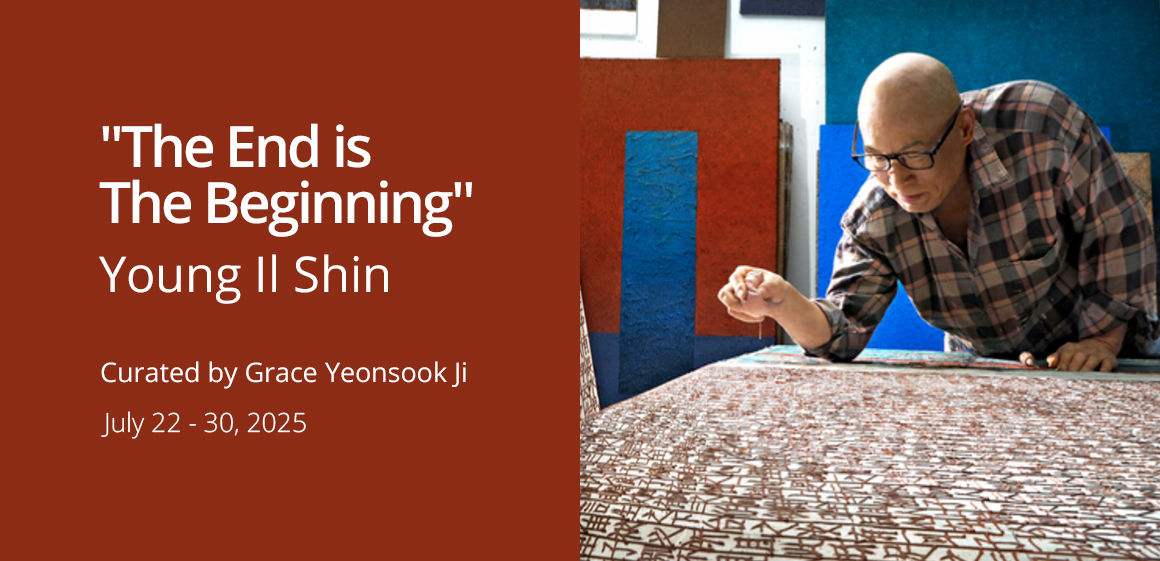
“The End is The Beginning”, Young Il Shin | July 22 – 30, 2025

Opening Reception: Thursday, July 24, 2025, from 5 to 8pm
Exhibition: July 22 – 30, 2025
Exhibition hours 12 – 6pm
Young Il Shin is a Korean artist who has spent decades embedding Eastern spiritual philosophy into his work. His central motif is the Jikji, the world’s oldest book printed with movable metal type, published during the Goryeo Dynasty in 1377. Shin transfers this ancient Buddhist scripture onto canvas by carefully inscribing classical Chinese characters using yellow ochre (a natural earth pigment). Through a repetitive process of overlaying and erasing, he embodies the Buddhist concept of emptiness (空)—the cyclical interplay between existence and absence. As Shin himself states, “Filling is emptying, and emptying is filling.”
Key concepts in Shin’s work include:
Sisyphean Repetition: The act of writing and repeatedly erasing characters made of earth evokes the punishment of Sisyphus from Greek mythology. Shin poignantly notes, “Letters exist to be erased.” This infinite cycle of disappearance reveals the transient nature of all forms and beings.
Filling and Emptying: By layering and then erasing characters, Shin illustrates how fullness and void are two sides of the same coin. His repetitive gestures demonstrate the coexistence and mutual dependence of presence and absence.
Return to Purity: According to the artist’s notes, the process of erasing the written text symbolizes a spiritual purification—connecting people heart to heart, and cleansing inner impurities. It’s a path toward reclaiming one’s pure, original nature and achieving inner freedom.
Creative Process
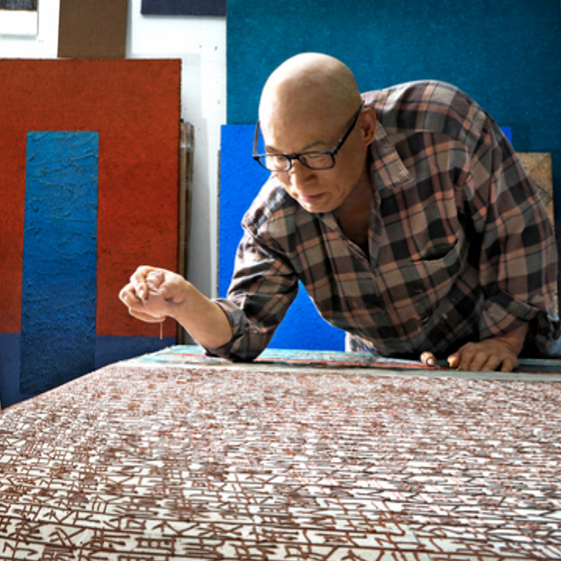
Shin uses a unique method that replaces the traditional brush with a custom-designed piping bag.
Writing: He mixes yellow ochre, glue, and water into a clay-like paste and loads it into the piping bag. With it, he painstakingly writes classical Chinese characters onto canvas.
Covering: He overlays the text with layers of ochre, powdered stone, pigments, and paint.
Repeating: This process of writing, covering, and erasing is repeated thousands of times, building dense, stratified surfaces. From a distance, his paintings resemble traditional East Asian ink wash on hanji paper, but a closer look reveals tightly packed characters embedded in the material. Each stroke is made with deliberate emotional and spiritual intent, while the layered textures evoke time, patience, and personal revelation. Within these strata lie hidden histories of memory and forgetting, covering and clearing.
Exhibitions and Recognition
Shin’s work has been widely exhibited both in Korea and abroad. Since his solo debut in Sydney, Australia in 2010, he has held 32 solo exhibitions and participated in over 60 group shows in major global cities including Italy, France, Japan, and the United Kingdom. In July 2024, The New York Times praised his work as “a contemporary reinterpretation of Korean cultural heritage,” earning him international acclaim.
Faith and Art
In recent years, Shin has begun creating artworks inspired by his Christian faith, shifting from the Jikji to classical Chinese translations of the Bible. For this New York solo exhibition, he undertook a monumental journey—starting with Genesis and encompassing the Four Gospels, Psalms, and all 27 books of the New Testament—culminating in a large-scale work titled That Day is Today. His approach represents a deeply personal intersection of traditional Eastern philosophy and modern spiritual belief.
At a time when material abundance often overshadows inner fulfillment, Shin invites the audience to reflect on the “aesthetics of emptiness” and rediscover spiritual stillness and meaning.
Born in Cheongju, Chungcheongbuk-do, Shin studied traditional East Asian painting at Seoul Institute of the Arts and later continued his art education at the École des Beaux-Arts in Reims, France. Despite facing personal hardships, including cancer and heart disease, he has never faltered in his artistic journey.
These experiences have infused his work with strength, depth, and spiritual resilience—qualities that radiate from his paintings